Every operator who buys disposables at volume knows the squeeze. Customers increasingly expect sustainable service, cities keep tightening single-use plastic regulations, and yet margins leave no room for pretty products that fail on the job or blow up the per-cover cost.
Bamboo disposables have become the answer for a growing number of restaurants, catering companies, and event businesses because they solve all three problems at once: they look and perform like premium service ware, they satisfy both regulators and eco-minded guests, and at wholesale volume the per-unit economics work. Here’s a practical look at building a bulk bamboo program, category by category.
Why Hospitality Is Moving to Bamboo
Regulations Are Only Going One Direction
Plastic straw and cutlery restrictions keep spreading across US cities and states, and the EU’s single-use plastic regulations banned plastic cutlery, plates, and straws outright back in 2021. Meanwhile, the FDA’s palm leaf dinnerware ruling pulled Areca palm leaf plates, a popular plastic alternative, off the US market entirely over food-safety concerns. Operators who standardize on bamboo now skip the scramble every time a new rule lands. Our full breakdown of the palm leaf situation is in Palm Leaf Plates Banned? Why Bamboo Is the Safer Disposable Plate Choice.
Guests Notice, and They Talk
Sustainability sells covers and books events. A natural bamboo place setting photographs beautifully, signals values without a word of copy, and gives servers a positive answer when guests ask what happens to the waste. For wedding and corporate clients specifically, compostable service is increasingly a requirement in the RFP, not a nice-to-have.
The Material Actually Performs
Eco-friendly disposables earned a bad reputation from paper straws that dissolve and thin plates that fold. Bamboo is different: the fiber is strong, rigid, and heat-tolerant. Forks spear, knives cut, plates carry sauced entrees, and straws last an entire service without going soft. Staff don’t need to double up items, and that protects your per-cover cost. Bamboo also arrives with credibility built in when it’s FSC-certified, meaning the sourcing is independently verified rather than self-declared.
Building Your Bamboo Program by Category
Cutlery
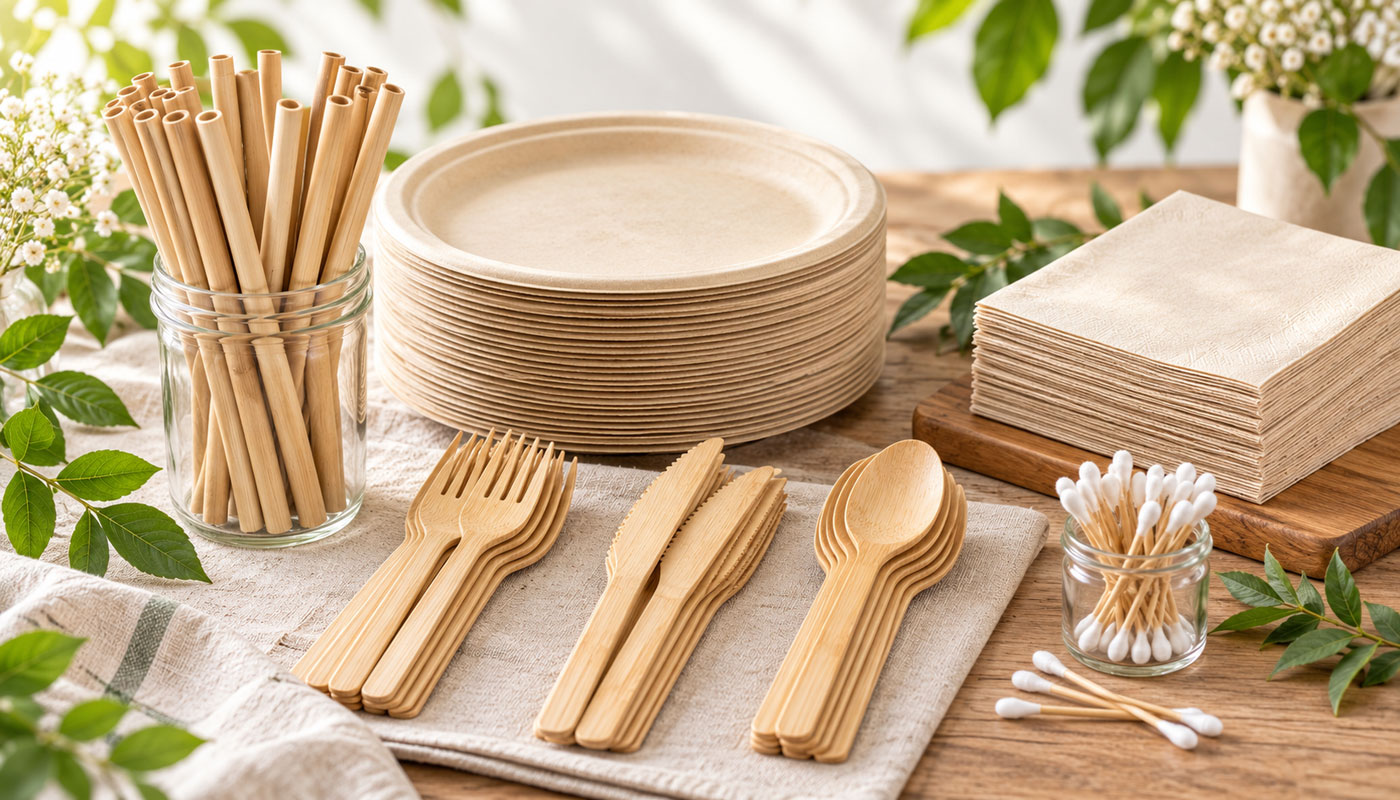
Bamboo cutlery sets cover the forks, spoons, and knives that quick-service, catering, and to-go operations burn through daily. The 100-pack configuration (50 forks, 25 spoons, 25 knives) mirrors real-world usage ratios, so you’re not left with a drawer of orphaned knives. The natural finish also upgrades a to-go bag in a way white plastic never will.
Plates
Bamboo disposable paper plates handle buffet lines, drop-off catering, and outdoor events where breakage rules out ceramic. With palm leaf off the market, bamboo fiber is the natural-look plate that remains fully lawful and food-safe, with no plastic lining to disqualify it from compost bins.
Napkins
Napkins are the highest-volume disposable in most operations, which makes them the fastest sustainability win. Jenvita produces all three service formats in bulk counts: cocktail napkins for bar and appetizer service, everyday napkins for counter service and takeout, and 3-ply entertain napkins for plated dinners and weddings. Sizing guidance for events is in our napkin buying guide.
Straws
Bamboo fiber disposable straws solve the paper straw problem every bar manager knows: they don’t get soggy mid-drink. They’re individually wrapped for hygiene compliance, hold up in cold and hot drinks alike, and compost after service.
The Operational Math of Buying in Bulk
Bulk bamboo earns its place on a spreadsheet, not just a values page:
- Per-unit cost drops sharply at case quantities, closing most of the gap with commodity plastic.
- One supplier, one reorder. Standardizing plates, cutlery, napkins, and straws with a single wholesale source cuts purchasing time and shipping costs.
- Storage is efficient. Bamboo disposables ship nested in compact recyclable cartons with no plastic overwrap to break down and discard.
- Waste hauling can get cheaper. If your operation composts, bamboo service ware diverts weight from the trash stream, and some municipalities price organics collection below landfill hauling.
- Marketing value is real. “Compostable bamboo service ware” is a line your sales team can use in every catering proposal and your social team can photograph endlessly.
Event planners get a bonus benefit: cleanup speed. When every disposable on the table is compostable, teardown becomes a single-stream sweep into compost bags. One of our most popular posts with hosts covers exactly this: how bamboo dinnerware simplifies cleanup after a party.
What About Disposal? Setting Up the Back End
To get full credit for compostable service ware, plan the disposal stream:
- Check your hauler. Ask whether your waste service offers commercial organics collection, and whether they accept fiber service ware.
- Label the bins. Clear compost signage at guest and staff stations is the difference between a compost stream and a contaminated one.
- Tell your customers. Table tents, menu footnotes, and proposal language turn your disposal program into a selling point.
Even in areas without organics collection, switching from plastic to bamboo still eliminates petroleum-based waste and microplastic shedding from your operation’s footprint. Details on the material’s credentials are on our sustainability page.
How Jenvita Wholesale Works
Jenvita’s wholesale program supplies the full bamboo line, cutlery, plates, napkins, straws, and swabs for hospitality amenity kits, at volume pricing. Every product is made from FSC-certified bamboo, free of plastic linings and chlorine bleaching, and shipped in recyclable packaging. Orders ship free, and returns are covered.
If you’re comparing suppliers, ask every candidate the same three questions: Is the bamboo FSC-certified? Is there any plastic lining or coating on fiber products? What’s the actual per-unit cost at your monthly volume? We’re happy to answer all three; contact us for a quote tailored to your order size.
Frequently Asked Questions
Is bamboo service ware allowed under single-use plastic bans?
Yes. Plastic bans target petroleum-based plastics. Bamboo cutlery, plates, straws, and napkins are plant fiber, so they’re a compliant swap in jurisdictions restricting plastic service ware. Always confirm local rules, since a few municipalities require certified compostability documentation, which FSC-certified, uncoated bamboo fiber products support.
How much more does bamboo cost than plastic disposables?
At retail, bamboo runs slightly higher per unit. At wholesale case quantities the gap narrows to pennies, and operators typically offset it through marketing value, fewer doubled-up items (bamboo doesn’t snap or sog), and in some markets lower organics hauling costs.
Can restaurants compost bamboo plates and cutlery?
Yes, where organics collection exists. Uncoated bamboo fiber products break down in commercial composting, and napkins compost even when food-soiled. If no commercial program is available locally, bamboo still biodegrades in landfill conditions far faster than plastic and sheds no microplastics.
Does Jenvita offer samples or small trial orders?
Retail pack sizes (50 to 250 count) work well as trial runs before committing to case volume. Reach out through the contact page and we’ll help you scope a trial against your service volume.
Partner with Jenvita for Wholesale
Premium look, compliant material, per-unit costs that work at volume. Bamboo disposables let your operation serve sustainably without compromising on performance or margin.
Ready to talk numbers? Explore Jenvita’s wholesale bamboo products or contact our team for volume pricing on cutlery, plates, napkins, and straws.
Shop Wholesale Contact Us