Scan the compostable cutlery shelf at any big-box store and you’ll mostly see one thing: white utensils made from PLA, a plastic-like material derived from cornstarch. They look eco-friendly, the packaging says compostable, and they’re everywhere. Bamboo cutlery sits nearby, visibly different with its natural wood-tone finish.
Both claim the same green credentials, so which one actually earns them? The answer matters more than most shoppers realize, because these two materials behave very differently in your hand, in hot food, and, most importantly, after you throw them away. Let’s run the comparison honestly, round by round.
First, What Is PLA Cutlery, Exactly?
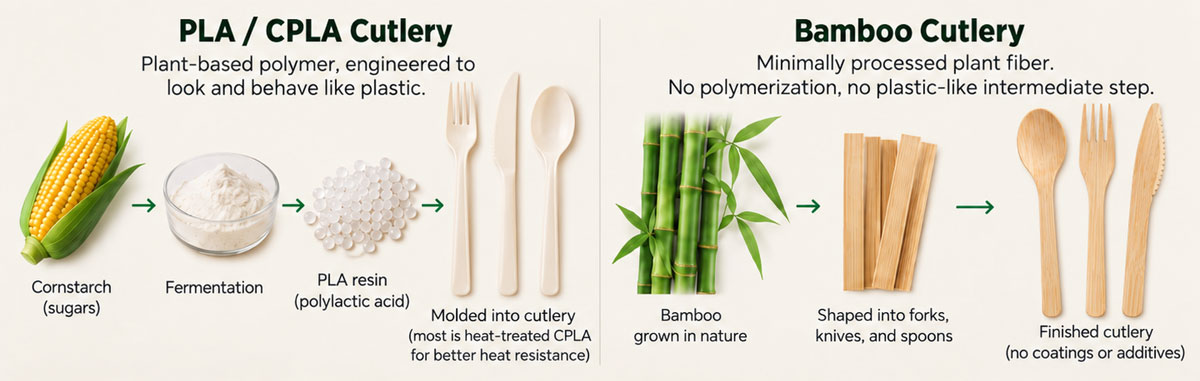
PLA stands for polylactic acid, a polymer made by fermenting the sugars in cornstarch into a material that looks and behaves like plastic. That’s the point: PLA was engineered to be a plant-based stand-in for petroleum plastic. Most PLA cutlery is actually CPLA (crystallized PLA), a heat-treated version that tolerates warmer food.
PLA is plant-derived and can be composted, so the eco marketing isn’t false. The trouble lives in the fine print, which we’ll get to in Round 3.
Bamboo cutlery, by contrast, is minimally processed plant fiber: bamboo shaped into forks, knives, and spoons with no polymerization and no plastic-like intermediate step. What you hold is recognizably the plant it came from. Details on how Jenvita’s bamboo cutlery sets are made without coatings or additives live on our sustainability page.
Round 1: Performance in Actual Food
Heat is where PLA shows its plastic DNA. Standard PLA utensils soften around 140°F, which a fresh bowl of soup or plate of hot pasta can reach. CPLA improves on that, tolerating roughly 185°F, but a CPLA fork in genuinely hot, oily food can still go rubbery mid-meal. PLA utensils are also molded thin to control cost, and thin PLA tines snap in dense food.
Bamboo fiber doesn’t have a softening point in any kitchen-relevant range. A bamboo fork stays rigid in hot chili, cuts through barbecue without flexing, and never goes rubbery, because it’s structural plant fiber rather than a heat-sensitive polymer.
Winner: Bamboo. Hot food is exactly what disposable cutlery exists for, and bamboo handles it without an asterisk.
Round 2: What’s Actually In It
PLA starts as corn, but getting from cornstarch to a fork involves industrial fermentation, polymerization, and molding, plus additives that vary by manufacturer. The corn itself is typically conventionally farmed commodity corn, grown with pesticides and fertilizer at scale.
Quality bamboo cutlery is closer to a single-ingredient product: bamboo, shaped. No polymerization, no dyes, and in Jenvita’s case, FSC-certified sourcing that independently verifies the bamboo was grown responsibly, without the pesticides or fertilizers bamboo doesn’t need anyway.
Bamboo also regrows from its own roots after harvest on a three-to-five-year cycle, a renewal story commodity corn can’t match, since corn is replanted and re-sprayed annually.
Winner: Bamboo, on both processing and farming footprint.
Round 3: The Compostability Fine Print
Here’s the round that decides the match, because it’s where PLA’s marketing and PLA’s reality part ways.
PLA is certified compostable, but read the certification: it applies to commercial composting facilities, which sustain temperatures around 140°F with managed moisture and aeration. Under those conditions, BPI-certified PLA breaks down in roughly 60 to 90 days, and that’s a legitimate green outcome, if your city has such a facility, if it accepts service ware, and if the fork actually makes it into the right bin.
Miss any of those ifs and PLA behaves like the plastic it imitates. In a backyard bin it just sits there, since a home compost pile never reaches industrial temperatures. In a landfill it can persist for years. And in the recycling stream it’s actively harmful: PLA looks so much like conventional plastic that it contaminates plastic recycling when guests toss it in the wrong bin, which at a real party is constantly.
Bamboo cutlery composts anywhere composting happens. Commercial facility, backyard pile, worm bin: it’s plant fiber, and microbes treat it like a branch. Dense handles take several months to a year at home, faster commercially, and snapping utensils in half speeds things up.
No special facility, no fine print. Our full explainer on compostability claims and certifications breaks down every label in detail, and our post on greenwashing tactics shows how “compostable” gets stretched in marketing.
Winner: Bamboo, decisively. A compostable fork that composts only in a facility most Americans can’t access is a conditional promise. Bamboo’s promise has no conditions.
Round 4: Cost and Practicality
PLA wins shelf ubiquity: big-box stores stock it in large counts at low per-unit prices, and it comes in familiar white. Bamboo typically costs slightly more per piece, though bulk packs narrow the difference to pennies, and wholesale pricing narrows it further for events and businesses.
Factor in performance, though, and the math shifts. Guests double up flimsy utensils and abandon rubbery ones mid-plate, so a box of PLA rarely serves as many meals as its count suggests. A bamboo fork finishes the meal it starts.
Winner: PLA on sticker price, bamboo on cost per meal actually served.
Bamboo vs. PLA Cutlery at a Glance
| Factor | PLA / CPLA Cutlery | Bamboo Cutlery |
|---|---|---|
| Raw material | Fermented cornstarch polymer | Minimally processed bamboo fiber |
| Heat tolerance | Softens ~140°F (PLA) / ~185°F (CPLA) | No kitchen-relevant softening point |
| Strength | Thin tines can snap or flex | Naturally rigid, splinter-free |
| Home compostable | No | Yes |
| Commercial compostable | Yes, ~60–90 days where accepted | Yes |
| Landfill behavior | Can persist for years | Biodegrades like plant matter |
| Recycling stream risk | Can contaminate plastic recycling | None; visibly not plastic |
| Look | White, plastic-like | Natural wood tone |
| Price | Lowest per unit | Pennies more per unit |
So When Does PLA Make Sense?
Fairness requires the caveat: if your venue or city runs a commercial composting program that accepts service ware, and your event controls its waste stream well enough that forks reliably land in the right bin, certified PLA is a defensible choice, and it’s genuinely better than petroleum plastic there.
For everyone else, which is most households and most events, bamboo delivers the outcome PLA only promises: a utensil that performs through a hot meal and then actually breaks down, wherever it ends up.
It’s the same conclusion we reached comparing bamboo vs. bagasse dinnerware: the simpler material keeps winning because there’s less that can go wrong.
Frequently Asked Questions
Is PLA cutlery really compostable?
Only in commercial composting facilities, which reach the sustained high temperatures PLA needs to break down. In a home compost pile or landfill, PLA persists like conventional plastic. Bamboo cutlery composts in both home and commercial settings.
Which is better for hot food, bamboo or PLA?
Bamboo. Standard PLA softens around 140°F and even heat-treated CPLA can go rubbery in very hot, oily dishes. Bamboo fiber stays rigid at any food temperature.
Can PLA cutlery go in the recycling bin?
No, and this is one of its biggest problems. PLA looks like recyclable plastic but isn’t, so it contaminates plastic recycling streams when it’s tossed in the wrong bin. It belongs only in commercial compost collection, where available.
Is bamboo cutlery reusable?
It’s built as a premium disposable, but sturdy bamboo utensils survive gentle hand washing for several uses before composting, a nice bonus for picnics and camping. Either way, end of life is a compost pile, not a landfill.
What is the most eco-friendly disposable cutlery?
For most situations, uncoated bamboo cutlery: renewable FSC-certified sourcing, minimal processing, strong performance in hot food, and compostability at home as well as commercially. PLA earns its green claims only where commercial composting infrastructure exists.
Pick the Fork That Finishes the Job
One of these forks softens in soup and needs an industrial facility to disappear. The other cuts brisket and composts in your backyard. The compostable cutlery comparison isn’t as close as the shelf makes it look.
Serve your next meal on the material that keeps its promises: Jenvita’s bamboo cutlery sets, FSC-certified, splinter-free, home compostable, and shipped plastic-free.
Share the Bamboo vs. PLA Comparison
Know someone trying to choose between bamboo and PLA cutlery? Share this infographic for a quick breakdown of the biggest differences in heat resistance, materials, compostability, and cost.
Save it, share it, or send it to someone planning their next event.