Open the cabinet under almost any kitchen sink and you’ll find the same thing: a backup pack of paper towels, because the roll on the counter never lasts as long as you expect. Wipe a spill, toss it. Dry your hands, toss it. Drain the bacon, toss it. By the end of the week, a good share of the kitchen trash is white and crumpled.
Bamboo paper towels promise a different routine: tear off a sheet, use it, wash it, use it again. They come on a perforated roll and tear like the familiar kind, but they’re built for the laundry instead of the trash. So which one actually earns the spot on your counter? We ran both through the jobs a kitchen towel really does, round by round.
First, What’s the Difference?
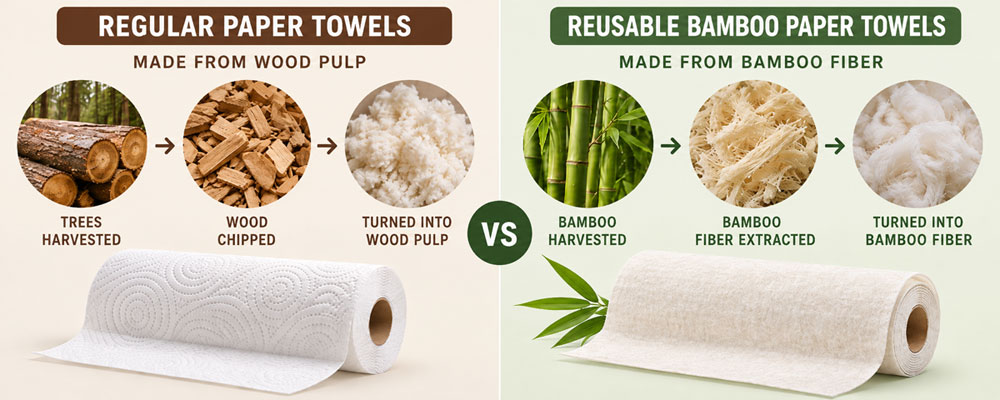
Regular paper towels are made from wood pulp, usually virgin fiber from trees, sometimes blended with recycled content. The pulp is typically bleached, pressed into thin sheets, and treated with wet-strength resins so the towel doesn’t fall apart the moment it touches water. Every sheet is designed for a single use. That’s the whole business model.
Reusable bamboo paper towels are made from bamboo fiber formed into a thicker, cloth-like sheet that still comes on a roll. You tear them off the same way, but each sheet is meant to be rinsed or machine washed and put back to work. Details on how Jenvita’s reusable bamboo paper towels are made live on our sustainability page.
Round 1: Absorbency and Strength
Regular paper towels absorb fast, which is why they’re the reflex grab for a tipped-over glass of juice. The problem is capacity. A thin sheet saturates almost instantly, so a medium spill turns into three or four sheets. Use a damp one to scrub a counter and it pills, shreds, and leaves lint behind. Half-sheet rolls exist because a full sheet gets wasted on small jobs and still falls short on big ones.
Bamboo towels are thicker and hold more liquid per sheet. They keep their structure when wet, so you can wring one out, keep wiping, and work at a sticky stovetop without the towel coming apart in your hand. One sheet can mop the spill, wipe the counter, and dry the faucet before it ever needs a rinse.
Winner: Bamboo. One sheet handles the job that usually takes a handful.
Round 2: What’s Actually in the Roll
A regular paper towel’s ingredient list is longer than the product suggests. Beyond the wood pulp, conventional towels can include bleaching agents, wet-strength resins, and, in printed varieties, inks and dyes. Regulators and researchers have also been looking harder at PFAS, the so-called forever chemicals, in paper products that contact food. If you dry produce, blot cooked food, or line a plate with a towel, what’s in the sheet matters.
Then there’s the source. Paper towels depend on wood pulp, and tissue products as a category have drawn criticism for their ties to forest loss. A tree harvested for pulp takes decades to replace.
Bamboo is a grass, not a tree. It regrows from its own roots after harvest on a three-to-five-year cycle and doesn’t need the pesticides or fertilizer that commercial timber and crop operations often rely on. Harvesting it doesn’t mean replanting a forest.
Winner: Bamboo, on both sourcing and what touches your food.
Round 3: Where Each Towel Ends Up
This is the round where the gap gets wide. A used paper towel almost never gets a second life. Most curbside programs won’t accept it in the recycling bin, because paper fibers get shorter every time they’re recycled, and towel fibers are already at the end of that line. Add food, grease, or cleaning spray, and the sheet is trash.
Plain paper towels can go in a home compost pile if they only touched water or food scraps. Once they’ve wiped up bleach spray or degreaser, they don’t belong there. In practice, most end up in a landfill, one roll after another, all year long.
A bamboo towel’s first stop after a mess is the washing machine, not the bin. Each sheet goes through cycle after cycle of use, so a single roll stays in rotation while a stack of disposable rolls would have come and gone. When a sheet finally wears thin, it can retire to rag duty in the garage. Our explainer on compostability claims and certifications covers what happens to bamboo materials after that.
Winner: Bamboo, decisively. The greenest towel is the one you don’t throw away.
Round 4: Cost Over a Year
Regular paper towels win at the register. A pack is cheap, it’s on every shelf, and nobody thinks twice before putting one in the cart. But it’s a purchase you repeat forever. Add up a year of 6-packs and 12-packs and the line item gets bigger than most households expect.
A roll of bamboo towels costs more upfront than a single roll of paper. Then it keeps working, wash after wash, while the paper towel budget drops toward zero. The longer you use it, the better the math looks. For cafés, offices, and rental properties that go through towels by the case, wholesale pricing widens the gap further.
Winner: Regular on sticker price, bamboo on cost per year.
Bamboo vs. Regular Paper Towels at a Glance
| Factor | Regular Paper Towels | Bamboo Paper Towels |
|---|---|---|
| Raw material | Wood pulp, often virgin fiber | Fast-regrowing bamboo fiber |
| Uses per sheet | One | Washable and reusable |
| Wet strength | Tears and pills when scrubbing | Holds together when wet and wrung out |
| Absorbency | Fast, but saturates quickly | Holds more liquid per sheet |
| Possible additives | Bleach, wet-strength resins, inks | Minimal processing |
| Recyclable after use | Generally no | Not needed; it goes in the wash |
| Upfront price | Lowest per roll | Higher per roll |
| Cost over a year | Recurring purchase | One roll stays in rotation |
So When Do Regular Paper Towels Make Sense?
Fairness requires the caveat: some messes are better thrown away than washed. Raw chicken juice on the cutting board, bacon grease you’d never want near your laundry, a pet accident, a cracked egg on the floor. For those jobs, a disposable towel is a reasonable tool, and keeping a small roll on hand is no failure.
Switching doesn’t have to be all or nothing. Let bamboo handle the everyday wiping, drying, and polishing, and save the disposables for the truly gross jobs. Just shop carefully, since “tree-free” and “eco” labels don’t always explain what a product is made of. Our post on greenwashing tactics shows what to look for.
How to Care for Bamboo Paper Towels
A little care keeps each sheet working longer:
- Rinse and wring out a sheet after light messes, then hang it to dry so it doesn’t sit damp.
- Wash used sheets with your regular kitchen towels, by hand or in the machine.
- Skip fabric softener, which coats fibers and reduces absorbency.
- Air dry or tumble dry on low heat.
Frequently Asked Questions
Are bamboo paper towels really reusable?
Yes. Unlike regular paper towels, bamboo paper towels are made to be rinsed or machine washed and used again. One roll stays in rotation for a long time, replacing many disposable rolls.
Are bamboo paper towels as absorbent as regular paper towels?
They hold more liquid per sheet. Regular paper towels absorb quickly but saturate fast, while thicker bamboo sheets soak up more and can be wrung out and reused mid-cleanup.
Can you recycle used paper towels?
Generally no. Paper towel fibers are too short to be recycled again, and used towels are usually contaminated with food, grease, or cleaners. Most curbside programs send them to the landfill.
How do you wash bamboo paper towels?
Rinse lightly soiled sheets and hang them to dry, then wash them with your kitchen towels by hand or in the machine. Skip fabric softener and air dry or tumble dry on low.
Are reusable paper towels sanitary?
Yes, when you wash them regularly and let them dry fully between uses. For raw meat juices or other high-risk messes, wash the sheet right away or use a disposable towel for that job.
Make This the Last Roll You Keep Rebuying
One towel shreds after a single wipe and heads straight for the landfill. The other wrings out, goes through the wash, and comes back for the next spill. The kitchen showdown isn’t as close as the grocery aisle makes it look.
Bring home Jenvita’s reusable bamboo paper towels: thick, washable, made from fast-regrowing bamboo, and shipped plastic-free.
Shop Reusable Paper Towels → Shop Wholesale →