Pick up a bamboo napkin and it feels like paper. It tears like paper, absorbs like paper, and composts like paper. So how does a hard, hollow grass that can grow taller than a house end up soft enough to wipe your face?
Most brands skip that question. The product page says “eco-friendly,” shows a photo of a bamboo grove, and leaves out everything in between. We’d rather show you the in-between. Here’s how bamboo paper products are actually made, step by step, plus an honest look at where the process beats wood pulp and where it still leaves a footprint.
The Short Answer
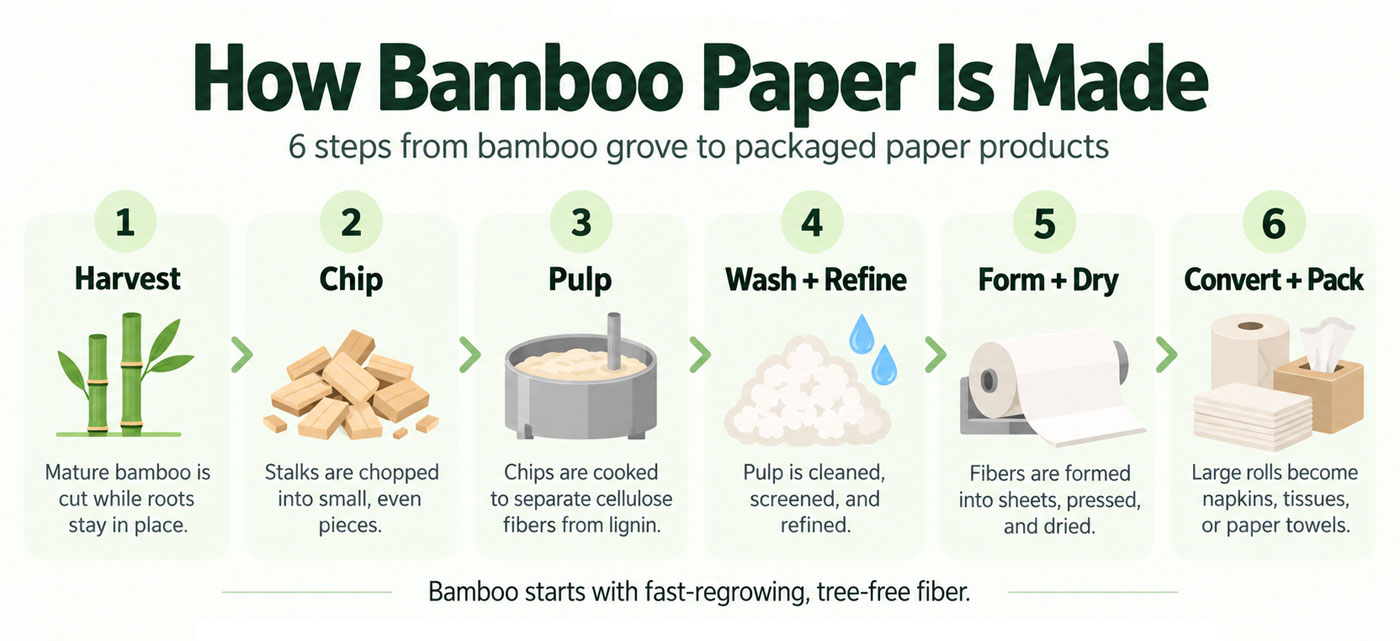
Bamboo paper is made the same basic way wood paper is: the plant is harvested, chipped, cooked into pulp, washed and refined, then formed into thin sheets and dried. The big difference is the starting material. Instead of trees that take decades to replace, bamboo paper starts with a grass that regrows from its own roots after harvest.
Step 1: Harvesting the Bamboo
It starts in the grove. Bamboo grows as a network of stalks, called culms, rising from a shared underground root system. Harvesters select mature culms and cut them near the base, leaving the roots in place. New shoots come up from those same roots, so a harvested grove doesn’t need replanting the way a clear-cut forest does.
Timing matters. Bamboo reaches harvestable maturity on a three-to-five-year cycle, and cutting only mature culms keeps the grove productive season after season. Responsible sourcing also means the grove wasn’t carved out of natural forest in the first place, which is what third-party certifications like the Forest Stewardship Council (FSC) are designed to verify.
Step 2: Chipping
The cut culms are stripped of branches and leaves, then fed through chippers that slice them into small, even pieces. Even sizing matters because the next step is a cooking process, and chips of the same size break down at the same rate. Screens pull out dust and oversized pieces before the chips move on.
Step 3: Pulping
Pulping is where bamboo stops looking like a plant. The goal is to separate cellulose fibers, the part that becomes paper, from lignin, the natural glue that keeps a bamboo stalk rigid.
Most bamboo paper is made with chemical pulping. The chips are cooked under heat and pressure in a large vessel called a digester, in a solution that dissolves lignin while leaving the cellulose fibers intact. What comes out is a brown, oatmeal-like slurry of loose fibers. Well-run mills recover and reuse much of that cooking solution rather than discharging it.
Mechanical pulping, which grinds fibers apart instead of dissolving the lignin, also exists. It leaves more lignin behind and produces weaker, stiffer paper, so it’s a poor fit for soft tissue products.
Step 4: Washing, Screening, and Sometimes Bleaching
The raw pulp is washed to remove leftover cooking liquid and dissolved lignin, then screened to catch knots, grit, and fiber bundles that didn’t separate.
Then comes a choice. Pulp at this stage is a natural tan color. It can stay that way, giving you unbleached bamboo paper with a warm, light-brown look. Or it can be whitened. Older methods used elemental chlorine, which can create harmful byproducts. Cleaner options exist: elemental chlorine free (ECF) bleaching swaps in chlorine dioxide, and totally chlorine free (TCF) bleaching relies on oxygen-based agents such as hydrogen peroxide. The Chlorine Free Products Association certifies products made without chlorine.
If you’re comparing bamboo paper brands, this is one of the most useful questions to ask: is it unbleached, and if not, how was it whitened?
Step 5: Forming, Pressing, and Drying
Next, the clean pulp is refined, a mechanical step that roughens the fibers so they bond to each other, and diluted with a large amount of water. That mixture is sprayed onto a fast-moving mesh screen. Water drains through, the fibers mat together, and a thin, continuous sheet begins to form.
The wet sheet is pressed to squeeze out more water, then dried. For tissue products like napkins, toilet paper, and facial tissue, the sheet is typically dried against a large heated cylinder and scraped off with a blade, a step called creping. Creping gives tissue its soft, slightly crinkled texture and a little stretch. Skip it and your napkin would feel like printer paper.
Step 6: Converting and Packing
Dried paper comes off the machine as huge parent rolls. Converting turns those into the products on your shelf. Sheets are layered into two or three plies, embossed for softness and absorbency, perforated, wound onto cores, or cut and folded into napkins and tissues.
Packaging is the last step, and it’s where plastic sneaks back into a lot of “eco” paper. Plenty of brands wrap bamboo rolls in plastic film. Jenvita ships plastic-free, so the last thing you throw away isn’t the thing you were trying to avoid.
What About Reusable Bamboo Towels?
Fair question, since they look like paper on the roll. Washable bamboo towels are usually made from bamboo-derived fiber rather than paper. The bamboo is processed into fibers that are bonded or woven into a cloth-like sheet built to survive the laundry. Same plant, different end product. We break down how they stack up against disposables in our bamboo vs. regular paper towels showdown, and you can see the reusable towels themselves here.
So, Is Bamboo Paper Actually Eco-Friendly?
The honest answer: it’s a much better starting point than wood, and the details still matter.
Where bamboo wins is the raw material. It regrows from its roots after harvest instead of being replanted, it reaches maturity in a few years instead of a few decades, and it grows without the pesticides or fertilizer that many crops depend on. Every sheet made from bamboo is a sheet that didn’t come from a tree.
Where the footprint remains is the factory. Pulping and drying use water, heat, and chemicals whatever the fiber. Most bamboo grown for paper comes from Asia, so shipping adds miles. And a bamboo label alone doesn’t prove the grove was managed responsibly.
That’s why transparency matters more than a green leaf on the package. Look for FSC certification, unbleached or chlorine-free processing, and plastic-free packaging. Our guide to greenwashing tactics covers the labels that sound good and prove nothing, and our explainer on compostability claims covers what happens after use. You’ll find how Jenvita handles each of these on our sustainability page.
Frequently Asked Questions
How is bamboo turned into paper?
Mature bamboo stalks are harvested, chipped, and cooked into pulp to separate the cellulose fibers from lignin. The pulp is washed, refined, formed into thin sheets on a mesh screen, pressed, dried, and then converted into rolls, napkins, or tissues.
Is bamboo paper better for the environment than regular paper?
In most cases, yes. Bamboo regrows from its roots after harvest and reaches maturity in a few years, while trees for wood pulp take decades. Processing still uses water, energy, and chemicals, so look for FSC certification and chlorine-free or unbleached options.
Is bamboo paper bleached?
It depends on the brand. Bamboo pulp is naturally tan, and unbleached bamboo paper keeps that color. White bamboo paper is bleached, ideally with elemental chlorine free (ECF) or totally chlorine free (TCF) methods. Check the packaging or ask the brand.
Is bamboo paper compostable?
Uncoated bamboo paper products such as napkins and tissues are plant fiber and break down in home and commercial compost. Keep out any sheets that have soaked up cleaning chemicals.
Does bamboo paper feel different from regular paper?
Not much. Softness comes from creping and embossing during manufacturing, the same steps used for wood-based tissue. Unbleached bamboo paper has a light tan color, which is the most noticeable difference.
Know What’s in Every Sheet
Every roll and napkin starts as a stalk in a grove that keeps growing after harvest. The difference between a good bamboo product and a greenwashed one is what happens next: how it’s pulped, whether it’s bleached, and what it’s wrapped in.
See how Jenvita sources and makes its bamboo products, then stock your home or business with paper you don’t have to second-guess.
Share the Bamboo Paper Process
Know someone who wonders how bamboo becomes paper? Share this infographic for a quick look at all six steps, from harvest to the finished roll.
Save it, share it, or send it to the friend who reads every label.